From microscopic models to emergent quantum phases
My research centers on correlated-electron and quantum many-body lattice models, with interests spanning unconventional magnetism (altermagetism, odd-parity magnets), topology, superconductivity, excitonic phases, orbital-selective Mott physics, and moiré systems. I am particularly interested in ground-state properties and collective excitations. More recently, I have been interested in the non-equilibrium dynamics, including quantum dynamics near criticality, and applications of quantum annealing.
Methodologically, we use unbiased numerical techniques with controlled analytical and mean-field approaches to access complementary physical regimes. We make extensive use of density-matrix renormalization group (DMRG) and matrix-product-state (MPS) methods for strongly correlated quantum systems, alongside exact diagonalization and other many-body techniques. I have also developed the efficient exact-diagonalization package SCS_Lanczos, which has been used in several collaborative studies.
Spontaneous Altermagnetism in Correlated Electron Systems
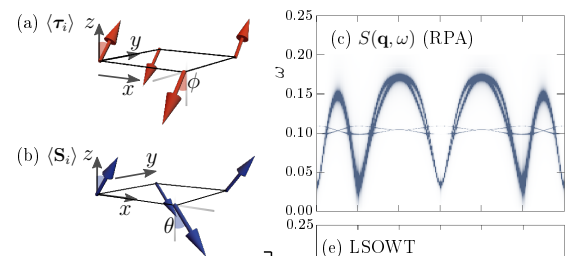
Our recent work explores how altermagnetism can emerge spontaneously in multi-orbital correlated systems. The interplay between spin and orbital order produces unconventional magnetic textures and distinct signatures in the collective spin excitation spectrum.
Coupled spin-orbital order and its dynamical response.
02
Altermagnetism · Hubbard models
Altermagnetism in a Modified Lieb Lattice
We investigated interaction-driven altermagnetism on the Lieb lattice as a model for quasi-2D oxychalcogenides. Using unrestricted Hartree–Fock and exact diagonalization, we identified spin-1/2 altermagnetic Mott insulating ground states at fillings of two and four electrons per unit cell.
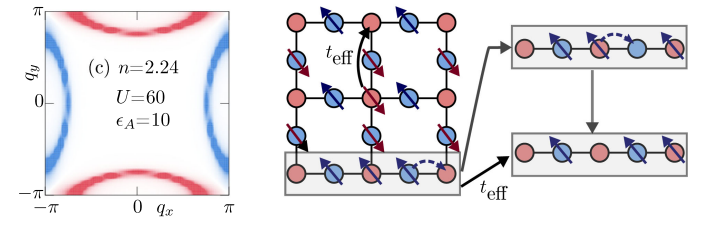
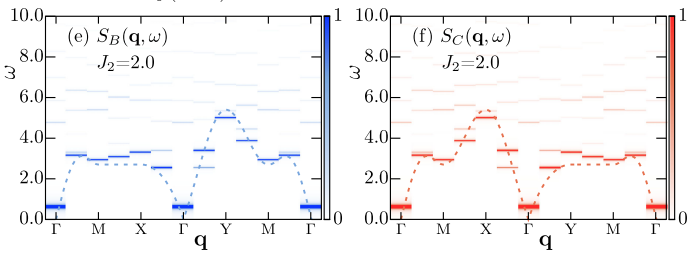
The characteristic spin splitting appears in both electronic and magnon spectra. Upon electron or hole doping, the model also supports altermagnetic metallic behavior with quasi-one-dimensional Fermi surfaces and dx²−y²-wave spin splitting.
Spin-split Fermi surface and the effective-chain description.Sublattice-resolved magnon spectra reveal altermagnetic splitting.
03
Spin-orbit coupling · Excitonic phases
Magnetic Excitonic Insulators
Using DMRG and unrestricted Hartree–Fock, we established antiferromagnetism driven by spin-orbit exciton condensation at momentum π in multi-orbital Hubbard models motivated by 4d/5d transition-metal oxides.
Follow-up dynamical DMRG and exact-diagonalization studies revealed a multi-branch optical mode alongside a low-energy Goldstone-like mode—an experimental fingerprint for candidate excitonic materials.
Generalized Wigner Crystals and Mott states in Twisted TMDs
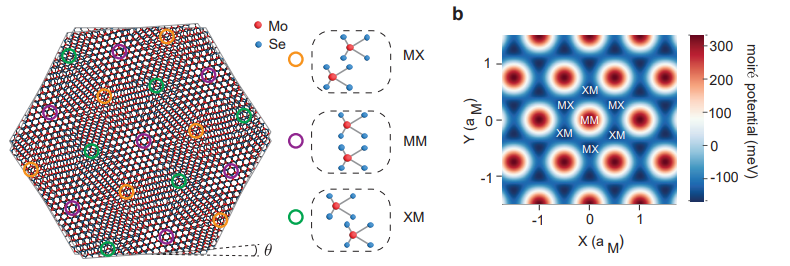
We studied moiré Hubbard physics in Γ-valley twisted TMD homobilayers—MoS2, MoSe2, and WS2—where honeycomb moiré bands host strong correlation effects. We predicted a sequence of generalized Wigner crystals at fractional fillings using unrestricted Hartree–Fock.
These predictions were later supported by experiments on twisted MoSe2 bilayers. In complementary work, we derived a moiré Kanamori–Hubbard model through Wannierization of composite low-energy bands.
Twisted MoSe2 lattice and the emergent moiré potential.
Quantum Simulation & Annealing/Computation
05
Quantum simulation · Non-equilibrium dynamics
Quantum Computation via Quantum Annealing
In collaboration with D-Wave Systems, we use coherent quantum annealing to simulate non-equilibrium magnetic dynamics near quantum critical points across several spin models, including higher-dimensional spin glasses.
Benchmarks against tensor-network and neural-network approaches reveal area-law entanglement trends and regimes where classical computational cost rises rapidly, positioning quantum annealers as promising tools for difficult quantum dynamics.